Last Updated on June 7, 2026 by Veeramani
You’re standing in front of a birthday cake, candles lit, family around you — and somewhere in the back of your mind a question creeps in:
“Wait… is this even okay in Islam?”
Sound familiar?
You’re not alone. Is birthday haram in Islam is one of the most Googled Islamic lifestyle questions in the world — and honestly, it deserves a proper, honest, human answer. Not a one-liner. Not a fatwa screenshot. A real conversation.
Because this question isn’t just about cake and candles. It’s about how we balance our faith with our family. It’s about loving our kids, honouring our parents, and celebrating life — without crossing a line we don’t need to cross.
Here’s what I can tell you upfront: the answer isn’t as black-and-white as some people make it sound. Scholars have different views. And understanding why they differ is actually really important.
So let’s walk through this properly — with respect for the deen, respect for different scholarly opinions, and zero judgment for where you land.
This is a safe space. Let’s figure it out together. 💛
“While you explore this question, you might also want to browse our 200+ Islamic Birthday Wishes Complete Guide — all messages are designed to stay within Islamic values.”
Quick Answer: Is Birthday Haram in Islam?
There is no direct Quran or authentic hadith that clearly forbids birthdays. Scholars differ — some consider it haram due to imitation, while others allow it as a cultural practice if it remains halal.Quran reference
First Things First — Why Do Muslims Even Ask This?
Let’s be honest — this question comes from a genuinely good place.
Muslims who ask “is celebrating a birthday in Islam allowed?” aren’t trying to be difficult. They care about their deen. They want to please Allah. They don’t want to do something wrong without realising it.
That’s beautiful. That’s taqwa in action.
And the reason the question exists at all is because birthday celebrations as we know them today — cakes, parties, candles, gifts — didn’t exist in the same form during the time of the Prophet ﷺ. So there’s no specific ruling that says “birthdays: yes” or “birthdays: no.”
What we have instead is ijtihad — scholars using Islamic principles to reason through a question the early texts don’t directly address.
And when scholars exercise ijtihad, they can — and do — reach different conclusions.
What the Quran Says (And Doesn’t Say) About Birthdays
Let’s go to the source first.
The Quran does not mention birthday celebrations. Not once. There is no ayah that says “do not celebrate your birthday” and there is no ayah that encourages it either.
What the Quran does say is this:
“O you who believe! Follow Allah and follow the Messenger and those in authority among you.” — (Quran 4:59)
“And whatever the Messenger gives you — take it. And whatever he forbids you — refrain from it.” — (Quran 59:7)
These verses establish that the Sunnah of the Prophet ﷺ is our guide. So the real question becomes: what does the Sunnah tell us about celebrations in general?
What the Hadith Says About Celebrations & Birthdays
This is where the scholarly conversation really begins.
The Two Eid Argument
When the Prophet ﷺ arrived in Madinah, he found people celebrating two particular days. He asked what those days were. They said they were days of play and celebration from their pre-Islamic traditions.
The Prophet ﷺ responded:
“Allah has replaced them for you with something better: the day of Adha and the day of Fitr.” — (Abu Dawud, authenticated)
Scholars who consider birthdays impermissible use this hadith as their main evidence. Their argument: the Prophet ﷺ replaced existing celebrations with the two Eids — implying Muslims shouldn’t add new celebration days from their own devices.
The Tashabbuh Argument
Another key hadith often cited:
“Whoever imitates a people is one of them.” — (Abu Dawud)
Tashabbuh means imitation. Some scholars argue that birthday celebrations are a distinctly non-Muslim tradition — borrowed from other cultures — and therefore fall under the prohibition of imitating non-Muslims in their religious or cultural practices.
What About the Prophet’s ﷺ Own Birthday?
Here’s something interesting: the Prophet ﷺ himself, when asked about fasting on Mondays, said:
“That is the day I was born and the day revelation was first sent to me.” — (Muslim)
He was aware of the significance of his birthday and he marked it — not with a party, but with extra worship (fasting). This has led many scholars to conclude that acknowledging the blessedness of a birth date is not inherently wrong in Islam.
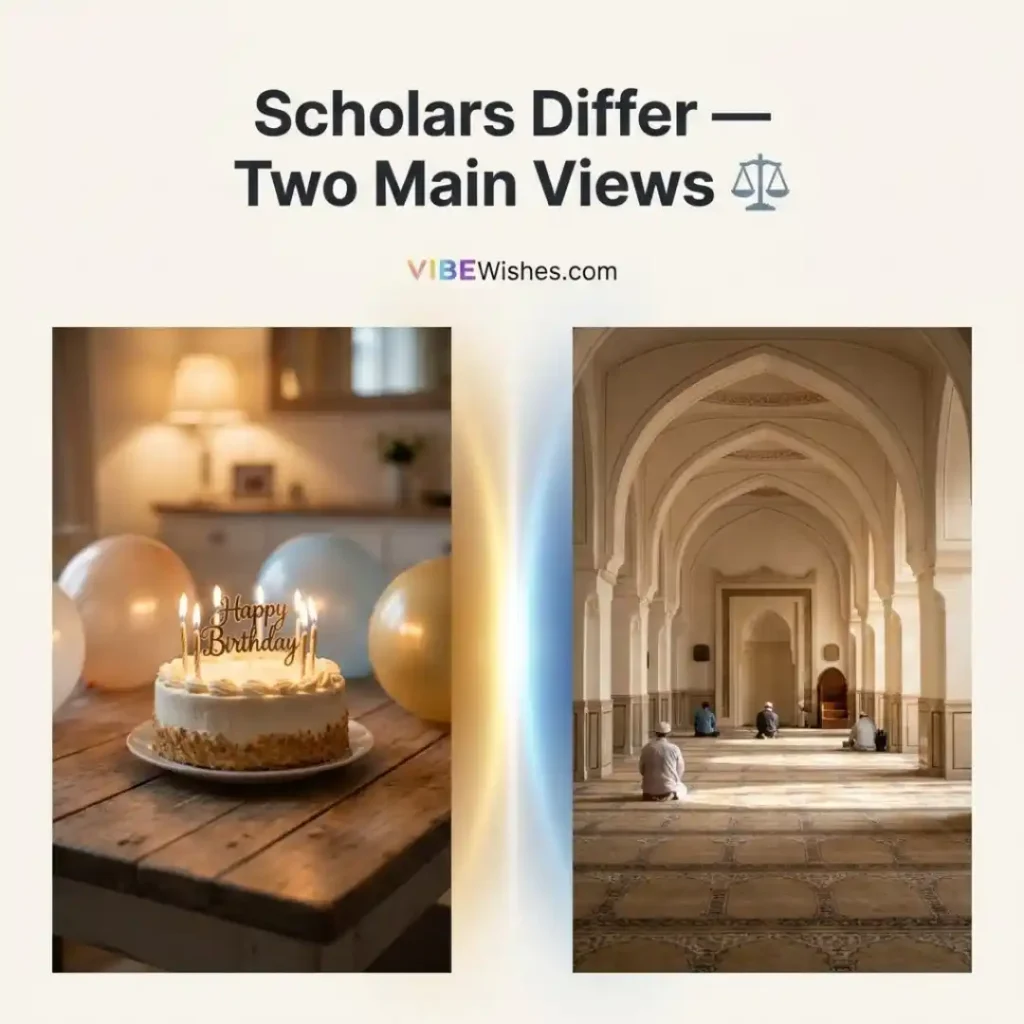
The Two Main Scholar Positions — Explained Fairly
🔴 Position 1: Birthday Celebrations Are Not Permissible
Scholars who hold this view — including Sheikh Ibn Baz (rahimahullah), Sheikh Ibn Uthaymeen (rahimahullah), and the Permanent Committee for Scholarly Research in Saudi Arabia — argue:
- Birthday celebrations were not practised by the Prophet ﷺ or his companions (Sahabah)
- The “two Eid” hadith suggests Muslims are not meant to add new celebratory days
- Modern birthday traditions (candles, cake, parties) have their roots in non-Islamic cultures
- The concept of bid’ah (religious innovation) applies when a practice is presented as an Islamic act
Their key point: If it wasn’t from the Prophet ﷺ and his companions, it shouldn’t be treated as a religious observance.
This is a respected, legitimate scholarly position. It comes from a place of genuine care for the purity of the deen.
“If you decide celebrating is permissible, our Islamic birthday prayer message page has 100+ complete duas — the most Islamic way to mark any birthday.”
🟢 Position 2: Birthday Celebrations Are Permissible
Scholars who hold this view — including many contemporary scholars, scholars from Egypt’s Al-Azhar, and various European and North American Islamic councils — argue:
- There is no clear, direct evidence prohibiting birthday celebrations
- The principle in Islam is that everything is permissible unless explicitly prohibited (al-asl fil-ashya al-ibaha)
- Tashabbuh (imitation) applies to religious rituals, not cultural customs — eating cake and singing happy birthday is not a religious act
- The two Eid hadith replaced specific pre-Islamic religious celebrations, not all forms of family joy and gathering
- Expressing gratitude to Allah for the gift of life on a meaningful day is, in itself, a good act
Their key point: As long as the celebration is free of anything clearly haram — alcohol, free mixing, music that is prohibited — it is simply a cultural gathering, not a religious innovation.
This is also a respected, legitimate scholarly position.
The Middle Ground — What Most Muslims Actually Practise
Here’s the truth that often gets lost in online debates:
Most Muslims around the world sit somewhere in the middle.
They celebrate birthdays as a cultural family moment — not as a religious act. They don’t treat it as worship. They don’t think they’re earning reward by blowing out candles. They’re just… gathering. Showing love. Making memories.
And when that’s the case — when the niyyah (intention) is simply family, love, and gratitude to Allah for another year of life — many scholars say there is nothing wrong with that.
The problem, as most scholars agree, comes when:
- ❌ Haram activities are involved (alcohol, unlawful mixing, prohibited music)
- ❌ It’s treated as a religious ritual on par with Eid
- ❌ Huge amounts of money are wasted israf (extravagance) while others are in need
- ❌ It becomes a competition of showing off (riya)
Remove those elements? Many scholars say: you’re fine.
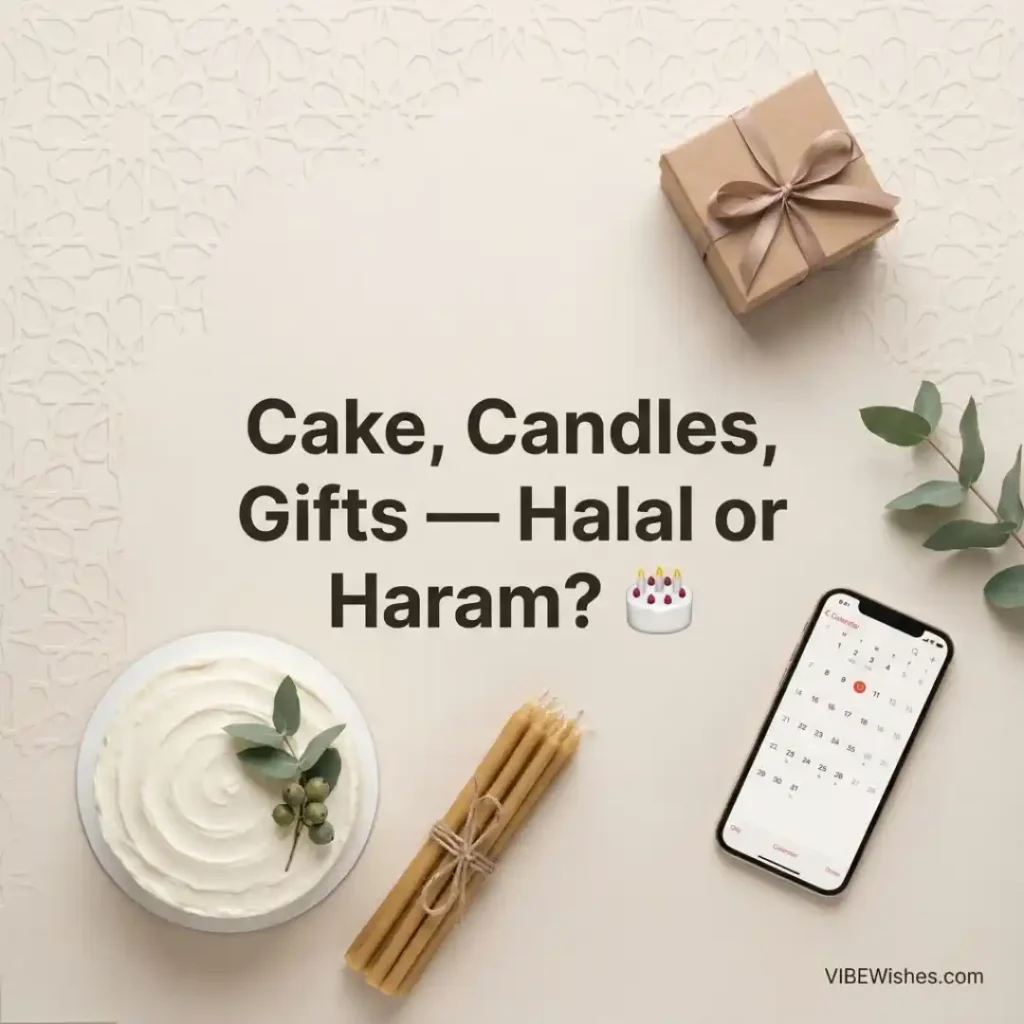
Is a Birthday Party Haram? Breaking It Down
Let’s look at the actual elements of a birthday celebration and assess each one:
🎂 Cake — Halal or Haram?
Eating cake with family? That’s just food and gathering. No scholarly basis for it being haram as long as the cake itself contains halal ingredients.
🕯️ Blowing Out Candles — Halal or Haram?
This is cultural, not religious. Scholars who permit birthdays have no issue with candles. Scholars who don’t permit birthdays often cite this as tashabbuh (imitation). Scholars differ. If it makes you uncomfortable, skip it — it’s not essential.
🎁 Giving Gifts — Halal or Haram?
The Prophet ﷺ actively encouraged giving gifts. “Give gifts to one another, for gifts remove ill-feelings from the heart.” — (Al-Adab Al-Mufrad). Gifts on a birthday? Generally seen as fine by all scholars.
🎉 Party / Gathering — Halal or Haram?
Family gatherings full of love and halal activity? No issue. The problem is when a gathering includes haram — alcohol, prohibited music, unlawful mixing. The gathering itself is neutral. What happens in it is what matters.
🎶 Music — Halal or Haram?
Music is its own broad scholarly debate. Scholars differ on what is and isn’t permitted. The key is: if the music is something you already consider permissible, it doesn’t become impermissible just because it’s at a birthday. Stick to your own established position on music.
📸 Photos & Social Media — Halal or Haram?
Sharing family moments is not inherently haram. But scholars caution against riya (showing off) and extravagance. Posting a birthday photo? Generally fine. Making it a display of wealth and status? Be careful.
What You Can Do Instead (Or In Addition)
Whether you celebrate birthdays or you don’t, there are some beautiful Islamic alternatives and additions that everyone agrees are wonderful:
🤲 1. Make a Dua for the Birthday Person
This is universally beloved. Stop. Raise your hands. Ask Allah to bless them with health, iman, and Jannah. It takes two minutes and it’s the most meaningful gift you can give. Check out our collection of Islamic birthday duas here.
📖 2. Recite Surah Al-Fatiha Together
Gather the family. Read Al-Fatiha with the intention that its blessings reach the birthday person. Simple. Powerful. Deeply Islamic.
“Instead of a generic party, try sending a Islamic birthday dua with Arabic text — authentic Arabic prayers are a beautiful, universally-accepted way to honour someone.”
💝 3. Give Sadaqah on Their Behalf
Give to charity on the birthday of someone you love. The reward goes to them. It’s a beautiful Islamic tradition that replaces the materialism of gift culture with something far more lasting.
🌙 4. Fast as a Form of Gratitude
The Prophet ﷺ fasted on Mondays partly because it was his birthday. You can fast on your birthday or the birthday of a loved one as an act of shukr (gratitude) to Allah for the gift of their life.
🕌 5. Pray Two Rak’ahs of Shukr
Offer two voluntary rak’ahs as a prayer of thanks for the gift of another year. It’s not a requirement — but it’s a beautiful act.
🎁 6. Give a Meaningful Islamic Gift
A copy of the Quran. A tasbih. A book of duas. A prayer mat. These are gifts that keep giving — long after the birthday is forgotten, the gift continues to be used in worship.
📝 7. Write Them a Heartfelt Dua Card
“Whatever you decide, our short Islamic birthday wishes collection gives 100+ clean, faith-rooted messages that work within any level of celebration.”
What About Children’s Birthdays?
This is where a lot of Muslim parents feel torn.
Your child’s classmates are having birthday parties. Your child wants what they see. You love your child. You don’t want them to feel left out. But you also want to raise them with proper Islamic values.
Here’s a balanced approach that many Muslim families take:
Keep it small, keep it halal, and keep the focus on gratitude.
- Have a small family gathering with halal food
- Make dua together as a family for the child
- Give sadaqah on the child’s behalf and explain to them why
- Give gifts (this is Sunnah!)
- Use it as a teaching moment: “We’re grateful to Allah for the gift of your life”
This approach avoids the excesses, avoids the haram, and still allows your child to feel celebrated and loved.
That’s not compromise — that’s wisdom.
What About Saying “Happy Birthday” to Someone?
Many Muslims wonder: even if I don’t celebrate, is it okay to say happy birthday to someone?
The vast majority of scholars who permit birthdays say: yes, absolutely.
Even scholars who are more cautious about celebrating birthdays generally have no issue with acknowledging a person’s birthday warmly — especially with a dua attached.
“Happy Birthday — may Allah bless your year” is not an act of worship. It’s an act of kindness.
And Islam is deeply, fundamentally, a religion of kindness.
The Intention Always Matters
Here’s the key principle that cuts through all the debate:
Niyyah — intention — changes everything in Islam.
If you gather with family on a birthday with the intention of showing gratitude to Allah for the gift of life, expressing love to someone you care about, and making dua for their wellbeing — that is a beautiful act.
If you do the same gathering with the intention of imitating a religious ritual that has no Islamic basis, competing with others in extravagance, or doing things that are clearly haram — that’s a different matter entirely.
The food, the gathering, the gifts — all of these are neutral. What you bring to them in your heart is what matters.
“This guide explains both sides — so you can decide with confidence.”
A Final Word on Scholar Differences
You’re going to hear people on both sides of this debate speak very confidently.
Some will say “it’s 100% haram” with great certainty. Others will say “it’s completely fine” with equal certainty.
The truth is: this is a matter of ijtihad. Scholars have genuinely and legitimately differed on it. Both positions have evidence. Both positions have respected, knowledgeable scholars behind them.
What that means for you is this:
- Choose the scholarly opinion that you follow with daleel (evidence), not just the one that’s most convenient
- Respect Muslims who hold a different view — they’re not wrong for following a legitimate scholar
- Don’t make this a cause of division in your family or community
- And whatever you decide — make sure your heart is in the right place with Allah
That’s the most important thing. Always.
Pro Tips: How to Navigate Birthdays as a Muslim
1. Decide your family’s position — and stick to it consistently. If you celebrate, celebrate with intention and within halal boundaries. If you don’t celebrate, don’t make others feel judged for doing so.
2. Always add a dua — regardless of your position. Whether you’re at a big birthday party or simply sending a text, add “May Allah bless you”. It costs nothing. It means everything.
3. Avoid extravagance (israf). Even scholars who permit birthday celebrations are clear: spending excessively is always wrong. Keep it modest and meaningful.
4. Protect the gathering from haram. No alcohol. No prohibited music. Appropriate mixing. These aren’t restrictions that ruin the fun — they’re the boundaries that make the gathering blessed.
5. Teach your children the Islamic perspective gently. Not “birthdays are haram and that’s final” — but “here’s why we do what we do, and here’s the beautiful Islamic intention behind it.” Children who understand the why carry it for life.
6. Don’t police other Muslims. Your Muslim friend celebrating their child’s birthday is not your responsibility. Give nasiha (sincere advice) only if asked. Otherwise, trust that they have their own scholarly guidance.
7. Use the day as a reminder of death — and therefore of iman. Every birthday is also a reminder that you are one year closer to your return to Allah. Use it to reflect, to make tawbah, to strengthen your deen. That is beautiful whether or not there’s cake involved.
🌟 More About Is Birthday Haram In Islam
Celebrating birthday in islam is a topic where scholars genuinely differ — and understanding both sides helps you make an informed, faithful decision.
The question of celebrating birthday in islam comes down to intention and method — how you celebrate matters more than whether you celebrate.
Many Muslims who were confused about celebrating birthday in islam find peace when they understand the scholarly nuances on both sides.
Is birthday celebration haram or halal? The honest answer is: scholars differ, and both positions have evidence behind them.
Whether birthday celebration haram or halal depends on what the celebration includes — alcohol, free mixing, and prohibited acts make it impermissible.
The birthday celebration haram or halal question has been answered differently by scholars in Saudi Arabia, Egypt, and Western Muslim communities.
The islamic view on birthdays is more nuanced than a simple yes or no — it involves ijtihad, intention, and the specifics of how the occasion is marked.
Understanding the islamic view on birthdays helps Muslims navigate a question that comes up in almost every family.
The islamic view on birthdays that resonates with most scholars is: making dua is always good; what matters is keeping any celebration halal.
Can muslims celebrate birthdays? Many contemporary scholars say yes — with conditions. The celebration must be free of anything prohibited.
Can muslims celebrate birthdays in a way that pleases Allah? Yes — by making dua, expressing gratitude, giving sadaqah, and keeping the gathering halal.
The question can muslims celebrate birthdays is one of the most searched Islamic lifestyle questions — and this guide gives you both sides.
The topic of birthday in quran and hadith is interesting — while the Quran doesn’t specifically mention birthday celebrations, it does mention the age of 40 as a milestone.
Understanding birthday in quran and hadith references helps Muslims approach this question with evidence rather than emotion.
There is no direct birthday in quran and hadith prohibition — which is why scholars use principles of ijtihad to reason through this question.
“Whatever you decide, our short Islamic birthday wishes collection gives 100+ clean, faith-rooted messages that work within any level of celebration.”
❓ Frequently Asked Questions
1. Is birthday haram in Islam — the short answer?
There is no direct Quranic verse or authentic hadith explicitly prohibiting birthday celebrations. Scholars are divided. Some consider it impermissible due to tashabbuh (imitating non-Muslims) and bid’ah (innovation). Others consider it permissible as a cultural gathering as long as it’s free of anything clearly prohibited. This is a legitimate scholarly difference — follow the evidence and the scholar you trust.
2. Did the Prophet ﷺ celebrate his birthday?
Not in the way we celebrate today. However, the Prophet ﷺ was aware of his birth date and marked it — by fasting on Mondays, partly because it was the day he was born. He did not have birthday parties, but he acknowledged the significance of the day through worship.
3. Is saying “Happy Birthday” haram in Islam?
The majority of scholars, including those who have reservations about birthday parties, have no issue with wishing someone a happy birthday — especially when it’s accompanied by a dua like “May Allah bless your year.” It’s an act of kindness, not worship.
4. What is the Islamic alternative to a birthday celebration?
Beautiful Islamic alternatives include: making a collective dua for the person, giving sadaqah on their behalf, offering optional prayers of shukr, fasting as an act of gratitude, and giving meaningful gifts. These can be done in addition to or instead of a birthday celebration.
5. Can Muslims celebrate their children’s birthdays?
Many scholars who permit birthday celebrations say yes — as long as the gathering is halal, modest, and free of anything prohibited. Keep the focus on gratitude to Allah, add a family dua, and avoid extravagance. This approach is followed by millions of Muslim families worldwide.
🔗 More From VIBEWishes.com You’ll Love
200+ Islamic Birthday Wishes Complete Guide
Short Islamic Birthday Wishes
Islamic Birthday Prayer Message
Islamic Birthday Dua With Arabic Text
Heart Touching Islamic Birthday Wishes for Wife
Heart Touching Islamic Birthday Wishes for Husband
Islamic Birthday Wishes for Child
Final Words 💛
You came here asking “is birthday haram in Islam?” — and the honest answer is: it’s complicated. And that’s okay.
Islam isn’t a religion that gives you a simple yes or no on everything. Sometimes it gives you a framework — principles, intentions, boundaries — and asks you to think carefully and follow trusted scholars.
This is one of those times.
What we know for certain:
✔ Making dua for someone on their birthday — always beautiful, always right ✔ Expressing love and gratitude — always encouraged ✔ Gathering with family in a halal way — no scholar has a problem with that ✔ Keeping things free of haram — the most important thing, regardless of your position
Whatever you decide — celebrate or don’t celebrate, party or a quiet dua at home — make sure Allah is in the middle of it.
That’s what makes any moment Islamic.
Not the absence of cake. Not the presence of candles.
The presence of Allah — in your niyyah, in your dua, in your gratitude for another year of the extraordinary gift of life.
May Allah bless every year He gives you. May He make each one more beautiful than the last. And may He accept everything you do for His sake. Ameen. 💛
“Reviewed with references from classical and contemporary Islamic scholars.
Disclaimer: This article presents a balanced overview of scholarly opinions for educational purposes. For personal religious rulings (fatwa), please consult a qualified Islamic scholar you trust.

“Veeramani is a content writer at
VIBEWishes specializing in Islamic birthday
wishes and heartfelt relationship messages.
Passionate about helping people express
emotions through meaningful words.”
7 thoughts on “Is Birthday Haram in Islam? The Complete Islamic Guide With Scholar Views & What You Can Do Instead”